Pages

Saturday, 21 November 2015

Travelclog Greece

With the onset of autumn in the UK, late October offered the opportunity for a nice break in sunnier climes and like the Blur song lyric, I found myself following the herd down to Greece, on holiday.

As with cycle excursions that have been subject of previous editions of The Clog, our tour company was Oak Hall. The holiday makers were met by the ever friendly and efficient dispatch team at Heathrow Terminal 5 and said goodbye to the UK as we took off on the Saturday lunchtime British Airways flight to Athens  at the start of the half term week.


We arrived late on the Saturday evening and were introduced to our leadership team from the tour company. Oak Hall always provide a member of the team for pastoral care who also lead non-compulsory sermons each evening, this task was fulfilled by Wesley who showed great attention to detail in preparations and took time to get to know people. The main tour leader was the incredibly cheery Charissa who led the trip with distinction and good humour, though I do like to think that the job was made easier in that we weren't exactly a tough crowd.

Our accommodation  was the basic but pleasant Thomas Beach Hotel near to the sea front. There was a nice pool area and views out to the hills from the rear of the building. This was a comfortable base for the week with friendly staff who looked after us well.


The first day in Nea Makri was spent at leisure and a large group headed out on a long coastal walk along the bustling promenade and into the nearby town of Marathon. 


A small group of us embarked on a detour through to the site of the ancient Battle of Marathon and in our world dominated by corporate messages, it was refreshing to see that it hadn’t been rebranded as the Battle of Snickers. Gaining access to the site cost €3 and there were some good information boards discussing the seemingly improbable victory of the Greeks against the larger Persian army. In the middle of the site lies a large mound where the remains of the slain are buried.


On the way back to the hotel, we stopped by a smart café bar for afternoon coffee. It was a shock to British sensitivities to be back in a bar that tolerate smoking. One of the options on the list was caffe latte freddo, though this wasn’t a coffee with melted chocolate caramel bar. There was also 'Nescafe' listed but this was barista style premium coffee rather than instant granules.

Our first organised day was to the historical area of Corinth, a city that was an important trading centre in the days of the Roman Empire. The first stop on the day was overlooking the fascinating Corinth Canal that links the Gulf of Corinth in the Ionian Sea with the Saronic Gulf in the Aegean Sea. This amazing feat of engineering was completed in the 19th century by a French company, almost over 1900 years since early attempts by the Roman Empire to construct a canal using thousands of slaves.


The second part of the visit took us up to the site of Acrocorinth, the imposing rock overlooking the city that was a major fortification. In ancient times, a temple dedicated to Aphrodite, the goddess of love, was also based on this site. There were some stunning panoramic views over the Gulf of Corinth from the summit.


 Following this, our coach then made its way down the narrow roads to the ruins of the ancient city, a place that is associated with the visit of the Apostle Paul, who established an early Christian church during his 18 month stay in the area. As historical figures go Paul is pretty controversial, as in his previous guise as a Pharisee, he had shown himself to dabble in persecution of minority groups and would’ve probably been guilty of genocide had the course of his life stayed on the same path.

After his astonishing conversion on the Damascus Road, Paul could be considered argumentative, difficult, single-minded and stubborn. These are qualities that are also associated with driven and motivated individuals, enabling Paul to be a pioneering, visionary evangelist. His two letters to the fledgling Corinthian church are a prominent part of New Testament scripture and the 13th chapter of his first letter is quoted at almost every Christian wedding ceremony. This text was inscribed on a plinth in the grounds of a church overlooking the ruins of the ancient city.


The ruins featured an imposing temple of Apollo, the god of the sun. It was clear from the ruins that worship of the established pantheon of Olympian gods were established here. Against this backdrop, one can only respect the achievement of the Apostle Paul in being able to plant a new church in this great commercial metropolis with entrenched religious beliefs.


 When walking near to the ruins of the temple, a foreign tourist heard us speaking and asked where we were from, one of our group lazily replied ‘England’ demonstrating a blatant disregard for the fact that there were people from all other areas of the UK and even a small amount from the other side of the world in our group. As an inclusive, fair minded publication, The Clog would not wish to name Mrs Rachel Lock as being guilty of this cultural faux pas.


One of the important events of the US Presidential campaign is a day known as Super Tuesday, our second free day could also lay claim to this title on the basis that it met the criteria of being super and also happened to be Tuesday.  A group of us decided to embark on a three island cruise in the Saronic Gulf with Olympic Cruises, costing €65. This involved a very early start as we left the hotel around 0615 and picked up more passengers at another hotel. Athens hosted the 2004 Olympic Games and the Tae Kwon Do venue overlooked the marina, this impressive looking building is now something of a white elephant that has seldom been used, in many ways a symbol of the economic troubles that the country is facing.


As we got underway, there was time to admire the cityscape of Athens and Piraeus, with the imposing stadium of Olympiacos CFP, the most successful football club in Greece, being a significant fixture of the seafront panorama.


As we navigated our way beyond the marina, we hit the busy shipping channels, navigating past many cargo ships heading for the container port at Piraeus, the huge vessel dominating the horizon on a journey that originated in Hong Kong and would continue to the large north European ports in Rotterdam and Hamburg.


The outbound voyage was quite peaceful, accompanied by traditional Greek music. Our first port of call was the island of Hydra after pleasant voyage of over 2 hours. Our boat was sitting outside the harbour for a few minutes as it waited on a Hellenic Seaways catamaran depart for the mainland, one of a series of high speed craft that link the Saronic Gulf islands with the mainland. 


As we entered the harbour, we were greeted by the sight of a beautiful little port town that had plenty of charm. We went on a leisurely walk around the town centre, where there was a good atmosphere as a parade was taking place. 


Our group took a walk up to the site of  old battlements that were a strategically important lookout point and a good place for a team photo.

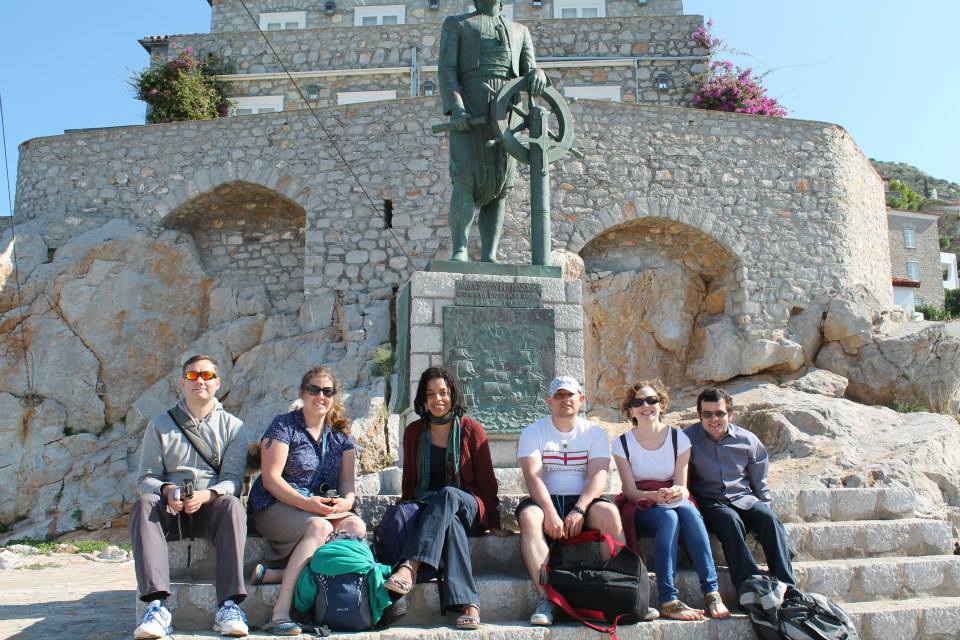

On our next stage of the voyage, an agreeable two course lunch was served. The cruise company were quite crafty in including food within the cruise tariff but leaving drinks as a cost option. The cruise company were quite crafty in including food within the cruise tariff but leaving drinks as a cost option.Our second stop was a brief stop at the sun kissed island of Poros. 
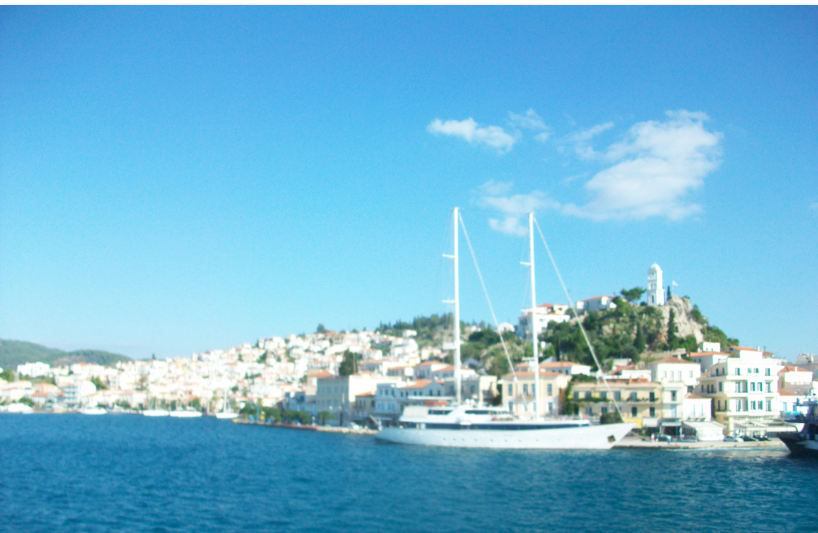

We only had 40 minutes here but this was enough time to visit the Clock Tower that sits above the town, offering panoramic views of the harbour. 


There was also a large Greek flag on a rock by the Clock Tower and Andy seemed to get carried away with many many legends of Greek military victories in days of yore by positioning himself as the conqueror of the nation,


The final stop of the day was on the island of Aegina, where we stopped off at the main town of Egina. This was a busy port town with numerous ferries stopping off before heading back to the mainland. We took the opportunity to stop off at a nice seafront café and walk down to the beach. 


Our group headed into town to the area near the marina to admire the Church of the Virgin Mary, before heading back to the boat just as the sun was setting.


We were underway on the final part of the cruise in tranquil waters as day gave way to night and the moon was rising over the island. 


Our group spent time sitting on the main deck of the boat being treated to a display of Greek dancing. The group then got up to participate in a communal traditional Greek dance. This was followed by a series of other dances and before long, some of the group were joining in with the Macarena just as we were navigating through the busy shipping channels in choppy waters. The voyage came to an end after 1930 though didn't get back to the hotel for more than 1 hour 15 minutes later due to heavy traffic in Athens as commuters were setting off for home.

The second organised excursion day started off with a brief stop off at the local Orthodox monastery. This featured some thought provoking iconography of Christian martyrs though our party arrived at a time when some form of service was taking place and were made to feel as welcome as a bacon sandwich at a synagogue. Examples include one member of our party being singled out for apparently not wearing appropriate clothing and at least one person was told not to take photographs. The picture below shows the main tower on the site.


Following this slightly sour experience, we headed to Agia Marina to catch a ferry for a 45 minute voyage to our main destination was the pretty seaside resort of Nea Styra on the island of Euboea. This was a pretty but very quiet location, partly due to the fact that most places were closed due to it being a bank holiday.


On walking through the main street, Steve stopped off at a cash machine at the local branch of Piraeus Bank who proclaimed themselves as the number one bank in Greece in an advert, an accolade that is up there with being the prettiest corpse in the mortuary. Rather like Old Mother Hubbard, when he got there, the cupboard was bare.


On the journey back to Nea Makri, we stopped off at Marathon Lake, with its imposing marble dam, to take in the sunset. 


Our evening began with a walk into town to visit the brilliant bakery and confectioner from which I had purchased a tasty chocolate cake for €0.50 the previous evening. We came away from the shop carrying two large boxes filled with so many cakes for around €26 that it felt like legalised looting.


We decided to have a more relaxed evening in the hotel lounge playing a board game. Unfortunately, the only choice presented to us was 2 in 1 Disney Princess of snakes and ladders or ludo. The game ended up with both Steve and Tim becoming increasingly competitive to become the top princess, and it was all tiaras, tantrums and bizarre mood swings as cries of 'I love Princess Ludo' or 'I hate Princess Ludo' could be heard in the ebb and flow of the game. This whole episode was undoubtedly metrosexuality at its lowest point.


The third organised excursion was to Athens, the capital city. We set off from Nea Makri and along the Marathon road. When we entered the city limits, we made our way to the site of the Panathenaic stadium that was used in the first modern Olympic Games of 1896. This was built on the site of an ancient stadium that hosted the Panathenaic Games in honour of the goddess Athena.


The main feature of our visit was a guided tour of the iconic Acropolis, a UNESCO world heritage site. The centrepiece of the site is the Parthenon, a temple dedicated to the goddess Athena, from whom the city derives its name. We learned of how Athena was born out of the head of Zeus in what really was the mother and father of headaches.


The Parthenon is undoubtedly the greatest icon of Athens, an essential part of its DNA in the same way as the Colosseum is to Rome and the Eiffel Tower is to Paris. In many ways, it is the eminent symbol of Greek civilisation even though there is much scaffolding in evidence as it undergoes renovation. On the day we visited, there were many tourists of different nationalities present and it was amusing to hear someone ask: “was Zeus a real person?”


Some of the treasures of the Parthenon are famously located in the British Museum, the hotly disputed Elgin Marbles. Our guide was diplomatic in saying that she doesn't  mind where they are located and was complimentary about the way in which the British Museum has looked after the sculptures, though she pointedly made reference to the new museum at the bottom of the hill which has space to accommodate the treasures. This impressive new building, located near the theatre of Dionysus, will be the cornerstone of future Greek bids to take back the priceless artefacts.


The tour gave us an insight to the contest between Athena, goddess of wisdom, and Poseidon, god of the sea, to become the patron deity of the city. Both of the gods had to present themselves before King Cecrops,the first king of the city, and produce a gift that would be to the benefit to all of the citizens. Cecrops was something of an odd creature in that he was half human and half snake, which seems to be a pre-requisite for a career in politics. The contest began when Poseidon struck the earth with his trident and created a well from which water streamed forth but this was salty and not much use to anyone. 

Athena struck the ground with her spear and planted an olive branch which naturally grew to be an olive tree. This was a gift of multiple dimensions as it gave the city dwellers olives, oil for cooking and lighting, as well as a source of wood for building. King Cecrops came to the conclusion that Poseidon was a bit of a one trick pony and Athena was able to claim the city. This contest was quite elaborate in the era before the invention of the penalty shootout. An olive tree sits at the Acropolis today on the spot where it is said that Athena had planted her tree.


The site of the Acropolis offers spectacular panoramic views of the city. It is possible to look out towards the four main mountains that sit above the city and out towards the Saronic Gulf.


Before leaving such a well known site, we decided to have the customary typical tourist photograph taken for posterity.


Following our cultural morning, we headed into the city for lunch and take in some of the other historical sites of this great city, including the Temple of Olympian Zeus, dedicated to the king of the pantheon of the gods.


On the way back to the coach, we headed to the heart of the city to witness the changing of the guard in front of the Tomb of the Unknown Soldier outside the parliament building in Syntagma Square, the area that is the beating heart of the modern city. The soldiers are members of the Presidential Guard, known as Evzones, standing proud outside their beach hut in traditional uniform that is derived from a design worn by Greek soldiers who fought against the Ottoman occupation.


Following the hustle and bustle of the capital city, we then undertook a 70km coastal road trip to Cape Sounion, the southernmost point of Attica, to take in one last Hellenic sunset in a site of great natural beauty, looking out to the Aegean Sea. This site is famous for its ruins of an ancient temple of Poseidon and is noted in mythology as being the spot where King Aegeus leapt to his death when he saw his son’s ship in the distance with a black sail, mistakenly believing that he had been killed in a clash with the Minotaur. It is from this king that the name of the sea is derived.


The final day of the holiday was spent at leisure in the Nea Makri, offering an opportunity to buy some last minute souvenirs. There were some upmarket boutiques in the town but you didn't need to scratch far below the surface to also find many disused shop units and unfinished building projects, each one an example of a dream broken on the altar of feckless fiscal policy.


It was also good to go out for lunch in another nice local restaurant and take in the nice coastal views that this pretty little town has to offer.


We had to leave Athens on the 0800 flight which meant that we departed Nea Makri so early that the night club was still in full swing.

Greece is a country that can lay claim to be an eminent civilisation in ancient times, recognised as a leading centre for philosophy, pioneer of mathematical advances and the cradle of democracy. There is a certain poignancy in realising that the nation of Plato, Socrates and Pythagoras of Samos that led the world in many ways, is now in an economic straitjacket with the standing of a second world country. Considering the predicament in which Greece finds itself, it is clear that this is a nation with a rich past that potentially faces an impoverished future.

Against this backdrop of financial crisis, this broken country needs tourism more than ever. Everywhere that we travelled, the Greek people were very welcoming. This beguiling land of myths and fables, with 227 inhabited islands and close to 5,800 more uninhabited islets empowers you to write your own odyssey, beckoning you to return time and again, safe in the knowledge that no two visits will ever be the same.


Monday, 7 September 2015

Solving the Migration Crisis

The world is facing the biggest migration crisis since World War 2, with the borders of Europe being tested to the limit. A game changing moment has been reached with the publication of a disturbing picture of a lifeless pre-school boy being washed up on a Turkish beach, pictures that seem too upsetting to republish. This edition will focus on what more can be done to resolve this pressing issue.

The UK has faced its own share of problems with migrants camping on the outskirts of Calais and regularly attempting to storm the Channel Tunnel terminal at Coquelles and climb aboard trucks on the motorway close to the terminal. This has caused many delays through the summer on both sides of the English Channel and has cost a lot of money in downtime for business. There has been much dialogue between the UK and French Governments but the centrepiece proposals have been better fencing near the terminal and an increased police presence. There has to be far quicker processing of applications with genuine cases of oppression and safely sending the others back to their countries.

Politicians have been quick to pass comment on the latest events in the crisis, with Labour leadership candidates being quick to make demands of an emergency debate on the issue and that the UK take more migrants. Interestingly, the frontrunner in the Labour leadership race, Jeremy Corbyn, has said that he would be willing to share his home with Syrian refugees though he has also come out against the UK taking further military action in Syria. The leader of the SNP, Nicola Sturgeon, also gave a speech that resonated with many people throughout the UK, speaking of shedding tears for the drowned infant and challenging the UK Government to take more refugees immediately. Sturgeon also commented that the Prime Minister had developed a ‘walk on by’ approach to the crisis.

The political discourse relating to the crisis brought back memories of a hymn from primary school, Cross over the road, the first verse of which says:

Would you walk by on the other side, when someone called for aid?
Would you walk by on the other side or would you be afraid?

It is perhaps rather unfair to say that the UK has been walking on by when our Royal Navy flagship, HMS Bulwark, has been playing a key role in rescuing thousands of migrants in trouble on the Mediterranean Sea. There have also been 5,000 refugees granted asylum in the UK since 2012 and £900 million in aid to assist vulnerable people in Syria and refugees in the wider area. This is a good start in responding to the crisis but just as the Prime Minister ordered a ‘full spectrum response’ to the terrorists who carried out the recent massacre of tourists in Tunisia, this approach must also be adopted for the wider problem of the migrants on the move and the reasons behind the displacement from their homelands.

Image result for hms bulwark migrant rescue

The UK has always been a country where people have been able to seek shelter in times of trouble. Reports in the press suggest that there is more than 8 million people in the UK who were born overseas, around 12.5% of the population. Our NHS would be severely diminished without all its contingent of manpower whose country of origin lies beyond these shores but any intake must be sustainable and control of the border must be maintained.

The Government will have to step up its efforts in taking more of the vulnerable refugees and the Prime Minister has just committed the UK to accepting 20,000 from Syria by 2020, though we can’t forget that there have been reports of a housing shortage in the UK, therefore numbers of incomers have to be proportionate to the number of dwellings available .The Government must ensure that UK citizens who are waiting for benefits, council houses or specialist treatment at hospitals, are not bumped down the pecking order otherwise this could lead to other social problems.

Ultimately, the seeds of the current crisis are in the execution of the War on Terror and a half cocked response to the rise of the Islamic State movement, known as ISIL. Following 9/11, one of the key objectives was to defeat Bin Laden’s Al Qaeda terror organisation and destroy the Taleban. Although aspects of the mission were fulfilled in that Bin Laden and his key lieutenants were taken out, terrorist cells were eradicated and the Taleban were on the run for a time, unfortunately there was no long term planning in terms of what comes next and that the coalition of governments did not realise they were fighting a multi-headed hydra.

In the last few years, ISIL have emerged as the biggest threat in Islamic extremism. The response has been a form of “hokey cokey” diplomacy with compromises on how far in the UK should go in its efforts to bring peace to Syria. The years of coalition government saw some military action in assisting the efforts in the Lybia civil war but only limited action on the shocking events in Syria who are establishing an Islamic Caliphate stretching from Syria into Iraq. Such a development has been detrimental to human rights in the region. Although the world has been shocked by the horrible pictures from that Turkish beach, the reality is that there have been blood curdling pictures of crucifixions, mutilated bodies and beheaded toddlers doing the rounds on social media for some time, all carried out by this depraved organisation against minority groups, especially Christians.

There also needs to be a strong dealing with those shadowy figures who are responsible for human trafficking, Europol have identified that there are 30,000 individuals involved with this abhorrent practice throughout Europe. These are the lowest form of scum and now that they have been identified, a concerted effort must be made to bring them to justice for their vile atrocities such as allowing many people to drown in boats that weren’t seaworthy and the suffocation of over 70 people in a meat wagon.

In the midst of the crisis, the term European Union is a complete misnomer, as the organisation has only succeeded in demonstrating a talent for disunity and bungling. It has been embarrassing to see European governments indulge in a game of pass the humanitarian parcel, blaming each other for the crisis. In recent times, there have been concerns that the Schengen agreement may be under threat. This agreement allowed passport controls at the internal border of many EU nations to be abolished. Such a move would be a massive backward step in freedom of movement.

Equally, the response of Arab nations has looked rather pathetic, especially the Gulf States that appear to have restricted the opportunity for Syrians to seek refuge there. The UN has rightly told the EU to take refugees but nations like Saudi Arabia, Kuwait and UAE need to do their share, especially since the Arab nations have closer cultural links to Syria.

In the mix of the migrant contingent making its way through Europe are a large number from the countries around the Horn of Africa. It is known that Islamic extremism is present in this part of the Africa and it is now time for progressive African nations to step up in the fight against the extremists who have infiltrated their continent. On his long weekend visit to the continent in the summer, President Obama noted that ‘Africa is on the move’, by this he was not talking about its citizens hiding in the back of trucks or in boats heading to Europe. It would be fitting for the last year of the Obama presidency to be characterised by marshalling resources to help drive out Islamic extremism from this part of Africa and allow people the opportunity to flourish in those nations.

Nations must wake up to the mass exodus of people making its way to Europe and realise that addressing the issues at the root of the problem are the only way of ensuring a long term solution. It is necessary that nations should look after those refugees fleeing situations where their lives are endangered, but we have to ponder the next move if the recommended number of 200,000 migrants are shared among the 28 EU nations.

The UN has to acknowledge that if this happens without any new resolutions to deal with ISIL and people trafficking, it will be far larger numbers making hazardous journeys to Europe in the near future. We must be left in no doubt that we are facing the biggest challenge to our values and way of life since WW2 in facing down the terrorists who have brought chaos to millions of lives.

There is no longer an option to dither and defer the need for action, the world has to wake up and brace itself for the largest military campaign and humanitarian effort of the current generation to defeat ISIL and its vile ideology. In addition, it is well within the capabilities of our national intelligence agencies and specialist forces to smash the trafficking gangs who have been responsible for the death of thousands over the last year.


All developed countries including the UK should be providing a safe haven for those in need whilst maintaining the needs of their own citizens. Overcoming evil to give self determination to millions of people in troubled parts of the world, rather than allowing them to be at the mercy of events is the best way forward in this crisis. This will be the best tribute to a young life cruelly snuffed out before it has really started and be to the benefit of humanity as a whole.


Sunday, 26 April 2015

In the Box Seat

One of the passions of The Clog is the motor car although it is a subject that was seldom covered in previous editions. A change of job role required the need to obtain my own car for the first time in a decade. Being a relatively high mileage driver, I decided that the best option would be a sporty diesel 5 door hatchback, with the chosen option being the Seat Leon FR 2.0 TDi (184 PS). This blog will now consider the Seat brand and its progress in the VW empire. There will also be discussion on the merits of the Leon FR and if it is worth acquiring.


Volkswagen Group are specialists in turning brands that were considered sows ears into silk purses. The classic example is their investment in Czech manufacturer Škoda, a brand that had a distinguished history in its early years before decades of Communist austerity ushered in an era of low quality product. The VW involvement in Seat pre-dates that of Škoda and in many respects was just as large a job as the brand was associated with selling re-heated Fiat product. They established the brand in other international markets, including the UK, with the Ibiza supermini, a product that had Fiat underpinnings and some German engineering courtesy of Porsche.  The new owners did a good job of keeping the first generation model fresh during its lifecycle, reaching many new customers across Europe.

The first product fully developed under the tutelage of VW Group was a spacious MK2 Golf based hatchback called the Toledo. A more significant development was the reveal of the second generation Ibiza in 1993 which was a more grown up model that introduced the supermini as an alternative to larger family hatchbacks. Since then, each subsequent generation of Ibiza has been among the best value vehicles in its class and the nameplate has become Seat’s most successful. VW also introduced the Seat Sport division that bolstered the brand’s presence in motorsport, building a presence in Touring Cars and the World Rallying Championship. In addition, Seat gained a halo effect through their Cupra sub-brand that has created some tasty hot hatchbacks in the last two decades.

At the other end of the scale, they have also turned around some luxury brands that were down on their uppers. In the late 1990’s, VW bought the storied Bugatti brand which had unceremoniously collapsed and turned it into the Concorde of the car world. They famously bought the quintessentially British Bentley brand in 1998, switching the product portfolio from automotive gin palaces to contemporary sporting luxury saloons and GT’s that appeal to an international audience.

It was reported that Volkswagen Group were contemplating purchasing the Alfa Romeo brand from Fiat Chrysler Alliance and there was speculation that Seat could be sold to make way for the Italian brand. Since the rumours first surfaced over two years ago, an ambitious product development programme was announced for Alfa, the first stage being the stunning 4C coupe and spider. It is difficult not to speculate that the Leon may have been sold as an Alfa Romeo Giulietta had history taken a different course.

Around the middle of the last decade, many of the products sold by Seat looked to be varying degrees of Leon.  Ambitious plans are in place to boost the brand’s presence with two smaller crossover vehicles that will compete in the segments dominated by the Nissan Juke and Qashqai. There are also plans for a larger crossover SUV vehicle, as shown by the 20v20 concept from Geneva. All of these developments suggest that the brand has a strong future and is targeting a younger customer base with an active lifestyle.

The latest generation Leon is built on the advanced MQB platform, an architecture that underpins the iconic VW Golf model. The platform is designed to generate operational efficiencies with up to 4 million units estimated to be built on this architecture by 2016, which is almost 40% of total VW Group’s worldwide production. The technicalities of the set-up have been a closely guarded secret but allows for modular construction, like a hi-tech Lego set.

One of the ground-breaking developments of MQB is that petrol, diesel and hybrid/electric cars can all be built on the same production line, in addition to vehicles from different brands. The platform also allows for lightweight construction with weight saving aluminium being used in components like the engine and suspension. The Leon FR TDi has a kerb weight around 75kg lighter than its predecessor. It is estimated that the MQB architecture will spawn 60 product variants across different brands.

The latest Leon range has expanded beyond the core five door hatchback to include a three door SC and ST estate variants, mirroring the strategy adopted for the iconic Ibiza range. All body styles of the Leon are very stylish and have found favour in the marketplace, with over 23,500 being sold in the UK last year. The brand are trying to shift from being reliant on their B-sector heartland to have a sales mix with more of a Leon base.

The FR TDi 184 PS holds a similar position to the Golf GTD in its range though the corresponding VW hatchback carries a £4K list price premium over the Seat, but does have the cachet of belonging to the iconic GTI family. The Mk 7 Golf is more appealing in the looks department than its’ immediate predecessors, though arguably the Seat design team had more freedom in what they could do with Leon. If these two cars were Disney characters, the Leon FR would be the free spirited Pocahontas whereas the Golf GTD would be Kocoum as it is so serious.

I specified the car with the Technology Pack which includes DAB digital radio, touch screen satellite navigation and the stylish full LED headlights. This is a real must have option on the Leon, market makers like CAP and Glass have created separate valuation listing for variants with the Tech Pack. In terms of colour, I selected the £530 Metallic Black option though the solid Emocion Red or metallic Nevada White are the signature colours that Seat have used in publicity material. The 17” alloy wheels in a 5 spoke design are the standard items for the FR model grade though stylish 18” options are available.


Transmission options are currently either the 6 speed manual, which I opted for, or the DSG twin clutch automatic. The latter option already conforms to EU6 emission standards whereas the manual conforms to the EU5+ standards. In terms of CO2 emissions, the manual variant records 109g/km compared to 119g/km for the DSG version. The recently introduced four wheel drive Leon ST X-perience is available with the same engine but with only with the DSG gearbox which suggests that there is a possibility of the manual 184 PS diesel option eventually being phased out. The engine is capable of propelling the car from 0-62mph in 7.5 seconds

As is the custom with many sporty hatchbacks, the driver can change the driving mode. The Leon has four different settings of normal, eco, sport and individual. For most journey’s, the normal setting provides a good blend of performance and economy. Selecting sport mode rewards the driver with feisty exhaust note and sharper responses. Eco offers a more gentle driving experience although the use of individual allows the driver the opportunity to combine the best characteristics of each core mode. The interior ambient lighting also changes depending on whichever mode is selected.


Cabin materials are of a very good standard for this class of car although not as high quality as those in the Golf or A3. Some of Seat’s earlier interiors could’ve been considered as previous generation VW parts bin specials, but it was difficult not to be impressed by the inviting feel of the interior. The steering wheel is a sporting design that fits in with the character of the car. The standard part-leather sports seats are comfortable though there is the option of alcantara or leather trim at additional cost.


The first journey in the Leon was over 450 miles from Sutton to Dalry in Ayrshire. This route took in a detour to Leatherhead and involved tackling the M25 at evening rush hour. Astonishingly, the trip computer informed that the average fuel consumption for the road trip was 50.1mpg, well above expectations of around 45mpg. This was a remarkable average considering part of the route involved keeping up with the fast flow of traffic on the M40 and Midland Expressway toll road, driving through very heavy rain in the North West and tackling the steepest parts of the M6 and M74. On a less busy and more pleasant return journey over the same roads, the average fuel consumption reached an excellent 57.3 mpg. The engine proved to be very strong and instantly responsive, rather than having the initial hesitancy that is evident in some diesels when accelerating quickly. There is also a good level of refinement and 70mph in 6th gear will show up around 1850 rpm. 


The daily grind for the car is a 9 mile commute between Leatherhead and Cheam in a mixture of 30 and 40 mph zones with the occasional tailback through Epsom. In spite of the low speed conditions and lack of free flowing traffic, the Leon has regularly returned almost 45 mpg in this environment. Other qualities have also shined through in the urban environment, such as an ability to remain composed over the uneven surfaces on the A232 near Ewell, demonstrating that the engineers have taken account of the need for a sports suspension that more forgiving.

It is a shame that the fuel tank is only 50 litres though this still does have a range of over 500 miles and getting a foam kit for punctures rather than a spare wheel does seem a bit cheap in a product with premium aspirations. The fact that these are the main niggles are testament to the car being well sorted mechanically and in terms of build.

The C-Sector marketplace is very competitive and having a product that is good, is just not good enough to achieve class leadership. Products such as the BMW 1 Series and Mercedes Benz A-Class have enjoyed sales success in the UK. The long established Alfa Romeo Giulietta offers buyers a feeling of exclusivity and a sporty drive, as proved by having driven almost 60,000 miles in a variety of these. In addition, the refreshed Ford Focus is still a standout product for its chassis set-up and the excellent Ecoboost engines are responsive and economical. Having driven the three cylinder version of the Ecoboost from the Surrey to Scotland via Bristol, it was difficult not to be impressed by its responsiveness. As this isn’t enough, the Korean opposition from Hyundai and Kia are becoming more accomplished, their investment in European production and quality improvements in the Cee’d and i30 models demonstrate that they mean business.


Of the core hatchback cohort built on the MQB platform, each has its own merits. The Škoda Octavia is the practical one, the Audi A3 has the most luxurious feeling interior, the all things to all men VW Golf redefines refinement and class in mainstream C-sector motoring. This leaves us with the Seat Leon and the only logical conclusion that can be reached with its blend of style, value and handling, is that Seat have created the Floyd Mayweather of the car world in short the best pound for pound competitor in its class. In many respects, the 184 PS FR TDi stands out as the pick of the range as it offers excellent performance and economy, though for the cost conscious family driver, a mid-range variant with Technology Pack and a frugal 1.4 TSi or 1.6 TDi will also offer a satisfying blend of cost effective motoring. 

Click for Options

Sunday, 5 April 2015

Easter

This time of year is characterised by a change in season and new life blossoming all around. It is also dominated by Easter, an event that provides the end game to the Christmas story with the crucifixion and resurrection of Jesus Christ.  This edition will focus on this festival and ponder its meaning.
Lee Ann Womack captures the astonishing events of that first Easter in a song called Something worth leaving behind, reflecting on key figures from history:

Hey Jesus, it must have been some Sunday morning
In a blaze of glory, we're still tellin' your story

Similar to Christmas, the Easter festival is dominated by commercialism as chocolate eggs are sold in every supermarket. These eggs are the sweetest part of Easter and meant to symbolise the stone that was rolled away from Christ’s tomb. Traditionally, the custom was for normal eggs to be decorated or dyed red and rolled in order to crack.


The story of Easter begins a week before the Crucifixion as Jesus Christ came to Jerusalem on a donkey, having heard of all his miracles, there were crowds there to mark his arrival, some of whom were proclaiming him as the Messiah and others who were just carried along with the excitement without much comprehension of what was happening. The Jewish rulers were keen to capture Jesus since he was viewed as a threat especially since reports emerged of Lazarus making the greatest comeback since…whatever the metaphor was prior to his own phoenix from the flames reappearance.
Jesus was arrested on trumped-up charges later that week and then put on trial where he told the rulers that he was the Messiah, which invokes a charge of blasphemy and the death penalty. One of the most famous moments of the trial is the fact that the Roman Governor, Pontius Pilate, tried everything to set Jesus free and famously washed his hands of his fate after giving the crowd the option of having Jesus freed or a notorious criminal called Barabbas.

Jesus Christ was then crucified on what we now know as Good Friday. This was a particularly barbaric form of death that was favoured by the Romans as a way of crushing dissent, especially political prisoners who could’ve been perceived as a threat. The process was particularly cruel with a nail through the heels and wrists, some crucifixions were upside down and there was different horrors visited upon the unfortunate victim.

The Gospels highlight that Jesus Christ was whipped, made to wear a crown of thorns and given vinegar wine to drink. He was also pierced in his side though by this time, the Canonical accounts report that he had given up his spirit. Even on the cross, it is reported that he showed compassion to one of the thieves who was facing the same death sentence. There are also accounts of the sky going dark, a time that was considered to be used for punishing Christ with the sins of mankind and the Jewish Temple curtain being torn in two, a symbol that everyone could now approach The Almighty directly.

The story took an amazing turn two days later with the tomb of Jesus being found empty and many sightings of him being reported by his followers in the weeks afterwards. The Apostle Thomas, famously doubted until he saw the risen Christ for himself, a reaction that could be viewed as being poignantly human rather than a sign of moral failure. The Resurrection was the one aspect of religion that separates the claims of Christ from other prophets and belief systems, causing persecution at different times in history. In the last few years there has been a resurgence in persecution among the Christian church in nations where the Islamic State movement has taken hold, a fact that was discussed by the Archbishop of Canterbury in his Easter message and was also mentioned by each of the three leaders of the UK’s biggest political parties.

Just as in the first century, the Easter story is viewed as controversial and inspirational in equal measure. For some, it is a stretching belief too far but throughout the centuries millions have regarded Easter as the extraordinary intermingling of horror and hope that an Almighty God initiated in order to reconcile mankind to him. Ultimately, it the decision to accept or reject is one that each person will reach with their own conscience. The essence of Easter is shown by Christian songwriter, Graham Kendrick, with these lyrics from one of his early songs, How much do you think you are worth:

Do you think they'll miss one in a billion
When you finish this old human race?
Does it really make much of a difference
When your friends have forgotten your face?

If you heard that your life had been valued
That a price had been paid on the nail
Would you ask what was traded,
How much and who paid it
Who was He and what was His name?

If you heard that His name was called Jesus
Would you say that the price was too dear?
Held to the cross not by nails but by love
It was you broke His heart, not the spear!
Would you say you are worth what it cost Him?
You say 'no', but the price stays the same.
If it don't make you cry, laugh it off, pass Him by,
But just remember the day when you throw it away

That He paid what He thought you were worth.

Image result for the crucifixion