Pages

Sunday, 25 December 2016

Christmas - Hope in the Darkness

2016 is not going to be a year that is remembered fondly in the annals of history. This was a year that saw the death of many prominent public figures, political upheaval and humanitarian crises. In the UK, the nation has spent the second half of the year coming to terms with the seismic decision to leave the European Union after 40 years of membership. This event caused division among families and communities, as those who wanted to leave the EU viewed the referendum as an opportunity to reassert UK sovereignty and minimise levels of immigration, those who voted to remain saw the economic benefits of freedom of movement.

The result of the vote cannot be unwound but it is the duty of everyone to ensure that they build bridges with colleagues, friends and family who may have had a different opinion on the issue. From this foundation, we must also make clear to our elected representatives that we want them to engage constructively with our European partners in ensuring as dignified an exit as possible from the EU and build the conditions for a prosperous future relationship.

In the USA, there was the most divisive election campaign in history culminating in the victory of Donald Trump, the flamboyant businessman who had never held any political office. This caused a backlash among supporters of the vanquished Hillary Clinton, some of whom took to the streets protesting with shouts of “we reject the President Elect”. There have been concerns over proposals to build a wall to keep out Mexican migrants and potential to increase investment in weapons of mass destruction.

Similar to the Brexit scenario, it will serve our world better for all sides in the USA to come together and constructively resolve to move forward together in the new era. This healing may not be something that happens overnight but shutting out other citizens over their political viewpoint has historically never been constructive in ensuring national cohesion. Equally for our own nation, we must hope our government demonstrates the discernment to be an able partner for the new President rather than turning our backs and renouncing any influence.

Another pressing issue in the past year has been the bombardment of Aleppo in the Syrian civil war. There has been many heart breaking scenes of pain and oppression from this war torn country. There may not be a single person who can bring the war to an end but the least we can do as citizens of a prosperous country is to do our best in supporting fundraising and humanitarian mission efforts to bring shelter and succour to a besieged people. We must also put pressure on our elected representatives to bring about a constructive end to the war rather than allowing a regional disagreement to potentially escalate into a world war and the biggest humanitarian crisis in world history.

In that first Christmas, we are introduced to young, expectant parents in the Middle East on a journey to register at a census during politically uncertain times and the arrival of a baby who is introduced to us as a gift from God to bring redemption and healing to mankind. We are presented with a story that has resonated through the ages with the qualities of inclusion and mercy, shining a guiding light to the heart of the human condition.

In the famous 1951 Christmas movie based on the 19th century Charles Dickens novel A Christmas Carol, the miserly Ebenezer Scrooge is taken to task by three spirits, with the spirit of Christmas Present pointedly noting that Scrooge had rejected the gift of the babe of Bethlehem and that we need to keep Christmas in our hearts every day of the year. The movie has a happy ending with Scrooge becoming a changed man by reaching out to the poor and showing a generosity of spirit to all. The closing scene of the movie proclaims that it was said of the newly changed Scrooge that he kept Christmas well.


As we look towards a new year filled with many challenges and apparent instability, it should be our hope that it will be said of us all that we keep Christmas well, demonstrating everyday kindness to all whom we encounter. If we want to create a better future, it doesn’t happen with muttering over big political events, but must start with us all trying to shape the world around us. The demonstration of kindness, mercy and generosity will be the true mark of keeping Christmas well in our own lives and be a reflection of the light that the old Christmas story brings to our lives, offering the opportunity for 2017 to be the antidote to a bitter and divisive year. A very happy Christmas and every blessing for the new year to you all.

Image result for nativity scene

Tuesday, 8 November 2016

USA Election

After a long and acrimonious campaign, it is time for the United States of America to go to the polls once more to elect a President. Following the two term presidency of Barack Obama, the nation will have a new figurehead of either Donald Trump or Hillary Clinton officially taking over the levers of power from January 2017.

Arguably, this has been the most poisonous presidential campaign in living memories featuring two candidates who clearly detest each other and polarise the voters. In many respects both sum up the American dream, Trump is the son of a property developer, who has taken over the business and grown the portfolio substantially, also branching into golf. Clinton is the daughter of a small business owner who became a Yale graduate, became a successful lawyer put her own political career on hold to allow her husband the opportunity to become President and has served as a Senator and Secretary of State. She now stands on the brink of becoming the first female President of the USA.

In the UK media and political circles, there has been a groundswell of opinion that a Trump presidency is unthinkable and a disaster waiting to happen. The new London Mayor, Siddiq Khan, had already blasted Donald Trump over his proposed restrictions on Muslims entering the USA and openly said that he is supporting Hillary Clinton. The First Minister of Scotland, Nicola Sturgeon, also made clear that she wants to see a Clinton victory during an interview on ITV’s Peston on Sunday programme.

Both Khan and Sturgeon may have thought that they were capturing the zeitgeist, especially since the ‘America First’ philosophy of the Republican nominee has caused alarm across the world, notably the suggestion of scaling back NATO and a hard line on immigration, however, both were probably better advised to use more diplomatic language in a public forum. Trump has been shrewd enough to speak of a trade deal with the UK in the wake of Brexit and we can’t ignore that he has business interests in Scotland through his golf and hotel empire.

In addition to his hard line policy position, Mr Trump has never been far from personal controversy during the campaign, with his belligerent persona, questions over his tax affairs, alleged past mafia ties, several bankruptcies, allegations of not paying workers appropriately and lurid sexual allegations, including an embarrassing video from 11 years ago discussing women in a degrading manner.

Clinton has adopted a more liberal agenda on the campaign trail, taking an approach that is designed to make the most of America’s soft power and viewing the nation as a force for good in the world. This has included discussion on further healthcare reform, LGBT rights, fast track path to citizenship for immigrants and tighter licencing on guns. She also has President Obama and his wife Michelle assisting in campaigning on her behalf, certainly displaying a more harmonious relationship than when Clinton and Obama were at loggerheads with both trying to secure the Democrat nomination for 2008.

Her campaign has been tainted by a scandal over using a private email server to transmit confidential official correspondence and attempting to delete the email trails. This matter is being investigated by the FBI and has the potential to derail the campaign. There have been other controversies bubbling beneath the surface such as the blurred lines between the charitable work of the Clinton Foundation and the lucrative speeches on the international lecture circuit. There are also questions over conflicts of interest in whether Clinton’s official role was influenced by the Foundation and about tax affairs. From a UK perspective, it is known that Clinton did not like the idea of Brexit and is unlikely to prioritise any application for a trade deal between our nations, following the line set by Obama.

The traditional best of three Presidential debates were also considered to be among the most ill-tempered and embarrassing in history. In spite of the allegations of sleaze that both candidates have faced, there has not been a smoking gun to take out either candidate. Although Clinton has consistently been ahead in the polls, Trump appears to be able to fight back. In a world where strategists like to create a range of voter personalities, Trump has arguably reached out to ‘Detroit Man’, the working class white man who is concerned about the USA losing its’ standing in the world, has seen a decline in job security with manufacturing jobs disappearing and having to compete with skilled immigrants. Clinton has found a core audience among the Frasier Set, the upwardly mobile, liberal, urban professionals.

Earlier polls in the lead up to the election suggested that Clinton had a comfortable lead though more recent polls though this has narrowed as Trump continued to press home his message about the alleged untrustworthiness of his opponent and using his dog whistle to tap into the concerns of ordinary Americans. The election result will boil down to who can mobilise their core vote and persuade the millions of undecided voters who are playing their cards close to their chest. This large constituency of undecided may be genuinely confused when faced with two underwhelming candidates or may not wish to disclose that they are voting for Trump, who is less popular in media circles. If this was the case, there would be the potential for a Brexit style shock result.

It seems unimaginable that a billionaire businessman could assume the role of the anti-establishment candidate but Trump has been occupying this ground, trying to appear as the man of the people. In spite of Clinton potentially becoming the first female to hold the supreme office in the USA, she is very much viewed as part of the establishment though it remains to be seen whether the Clinton brand will be seen as relevant as it was in the freewheeling economy of the 1990’s, during the ‘Great Moderation’ of Alan Greenspan’s imagination.

One of the unofficial accolades attributed to the President of the USA is that they are Leader of the Free World. For those of us who are not US citizens, we can only hope that the new President will maintain the standing of the USA as a beacon of democracy and enterprise. We can hope that they will be positive in their approach to Foreign Policy, facing down Russian grandstanding over Syria and working collaboratively to prevent another Cold War.  They will also have to do their best to reunite the USA as there could be protests following the election.

Following a presidency that ushered the first mixed race candidate into the Oval Office, the Obama years will be remembered as symbolic rather than being a future candidate to be carved into Mount Rushmore, though many will point to steadying the economy, the audacious capture of Bin Laden in Pakistan and bringing more healthcare reforms as key achievements. Obama also came across as an agreeable and witty person who was at ease in any social setting, a quality that lacks in either Trump or Clinton. All of those who jumped on the bandwagon of viewing Obama as the President of Africa and hailing him as a Martin Luther King figure are probably feeling short changed today. In light of 8 years that were mainly about steering the USA through the choppy waters in the wake of the financial shock of 2007/8, it is difficult to see either 2016 candidate assuming office for any more than a four year term in a transitional rather than transformational presidency.

In a race where there are two polarizing candidates, it is tempting to question whether the American dream needs to be reimagined. Some of the allegations made against both candidates have been unproven, embellished or historic, however, there are plenty of skeletons in both closets. Naturally, it would be good to see a candidate who is an internationalist with an entrepreneurial spirit and a track record of innovation that is designed to empower citizens in a low carbon, environmentally friendly, inclusive vision of the future assume control of the Presidency. Perhaps it is unfortunate that the name of Elon Musk is not on the ballot paper, but whatever the result on the 8th November, it is important that the UK seeks to engage the new President of the USA in a manner that will continue the special relationship that has shaped our nations throughout our respective histories.


Image result for usa flag


Wednesday, 22 June 2016

EU Referendum - In or Out?

June 23rd is set to be a significant day in our nation’s history as we face a referendum on the UK’s membership of the European Union. This edition of The Clog will explore whether we should continue in our membership or steer a new course.

The debate has reopened some of the schisms in the Conservative ranks with Boris Johnson becoming the face of the ‘Leave’ campaign. Johnson has made a career of playing the jovial buffoon but beneath the bumbling exterior, is a man with the fierce ambition to ascend to the highest office in the land. Some commentators have questioned if his campaign for Brexit is a calculated gamble to position himself for a quick transition to 10 Downing Street considering David Cameron’s position would be untenable in the event of a vote to leave.

There has been many spurious claims made from both sides. A poster featuring Nigel Farage in front of hundreds of migrants with the slogan ‘Breaking Point’ caused controversy, especially since the photo was taken in Eastern Europe and none of the migrants came to the UK. The NHS has also become a political football, with both sides suggesting different effects on an organisation that has become a national religion. One of the rare funny and typically British moments in the debate came on the 15th June when a ‘Brexit’ flotilla was intercepted by those supporting the campaign to stay in the EU.

If there is a political slogan that sums up the core of what the debate should be, it would be “It’s the economy, stupid”. We have just came through the largest economic shock since The Great Depression and markets do not like sudden change. Since early June, the value of Sterling has fallen in the markets compared to where it was in the previous month and has recently rallied in the wake of favourable polling news. In the event of a ‘Leave’ vote being returned, it is likely that the trend of a falling currency could continue. A falling currency would mean that our goods and services would be cheaper to export abroad but would mean that the cost of imported products would be higher and potentially lead to inflation. The Bank of England Governor, Mark Carney, has also suggested that a move away from the EU could lead to the economic recovery stalling and a potential recession taking place.

Those who favour the Brexit can point to sleaze at the heart of the EU. There have been many reports of cronyism, fraud and MEPs claiming large amounts of expenses over the last 20 years. There have also been cases where small business has complained about being hampered by unnecessary red tape by EU regulations. There have also been reports the Common Agricultural Policy creating mountains of food and drink produce that goes unused, this is quite shocking when there are nations where people starve. This demonstrates that there is the need for reform within the corridors of power at Brussels.

Leaving the EU could open up political unrest in our own nation as Nicola Sturgeon, leader of the SNP, has not ruled out requesting a second independence referendum if a Brexit takes place. There are some SNP figures such as their former deputy leader, Jim Sillars, who does not think that Scotland should vote to stay in the EU since the organisation was less than accommodating during the 2014 independence campaign. Sillars is now on the fringes of the Nationalist movement and his view may garner some sympathy but most SNP supporters would see the opportunity for a re-run of the 2014 independence contest. It would be a tragedy if we left one alliance and couldn’t hold together the alliance that has held our nation together for over 300 years.

The issue of immigration has become a political football in the course of the EU debate. Sadly, this has not been very well handled by either side, it is not uncommon to find the lines blurred when discussing migration of EU citizens and those migrants coming from international conflict zones fleeing persecution. The Office of National Statistics point out that the latest unemployment rate in the UK has fallen to 5% and the number of people in employment has gone up to 31.6 million, over 460,000 more people than in early 2015. This suggests that there is enough work for everyone and we aren’t seeing our own citizens pushed out in favour of migrants.

 Many of the EU migrants are young, have come from Eastern Europe and can be seen often in lower paid service industry, trades and retail jobs. There are also many who stay for a shorter time and go back to their own countries, a decision that is understandable when we see hi-tech automotive industry manufacturing and supply chain jobs having been created in Slovakia by VW, Peugeot-Citroen and Kia. They will be joined by the British icon, Jaguar Land Rover, who are making a £1bn investment in a factory which opens in 2018.

Citizens of our country have also taken advantage of the freedom of movement laws through buying a second home in some of the sunnier parts of Europe. Arguably, some of our citizens moving abroad have been less good at integrating than those EU migrants coming to our own nation.

The UK is the world’s 5th largest economy and a country which has been a major influence in the world. Our collection of islands sitting on the fringes of the Atlantic Ocean has achieved its status in the world by forming alliances with other countries rather than aiming for isolation. We are a member of all the top clubs such as NATO, G8, G20, the cornerstone of the Commonwealth, a major pillar of the European Union and possess special status as a permanent member of the United Nations Security Council. We are involved in all of these organisations because we are a nation that matters, always at the forefront of international diplomacy, talking quietly but wielding a big stick.

Critics of the EU have pointed out that Norway and Switzerland have their own trading arrangements to gain access to the Single Market without being members. What is often forgotten is that Norway is paying a substantial price for this privilege and doesn’t have a say in how the organisation is run. We can’t expect reform if we want to leave the club. It would also be naïve to assume that we would avoid contributing a nominal amount to any future bailout of Greece if we do achieve a competitive trade deal in a post-Brexit world as we can’t expect to take all the benefits from the relationship and not be expected to give something back. Ultimately, with previous Greek bailouts, the German taxpayers and other larger Eurozone nations did the heavy lifting in comparison to ourselves.

It is unlikely that the EU will be overly accommodating in helping us to achieve trade terms as favourable as those offered to other nations who haven’t been members as there would be concerns that the entire institution could unravel as other nations follow our lead. This would be quite concerning as we have had over 70 years of peace with former enemies now standing together as partners. In order to counter the prospect of an EU breakup, the remaining nations could also try and seek closer union much more quickly, which could destabilise the organisation.

The News International publication, The Sun, has come out in favour of Brexit. They point out the dangers of the UK becoming engulfed by a German dominated federal state. This does not seem likely as we have a two speed EU, with some states being part of the Eurozone and Schengen agreement and others, like the UK, who are not part of these treaties but still a full member of the European Economic Area and contributor to Defence.

There was a greater chance of the UK signing up for the Euro project back in the days of New Labour when figures like Peter Mandelson were close to the levers of power. Gordon Brown, then Chancellor of the Exchequer, famously introduced 5 economic tests for adopting the Euro:

1. Economic Harmonisation
2. Flexibility
3. Effect on Investment
4. Effect on Financial Services
5. Effect on growth and jobs

The first of these tests would require the UK economy to be moving in harmony with the Eurozone and economic cycles to follow a very close pattern. Scrapping Sterling would be a major blow for UK sovereignty and since the days of the New Labour project, the ship appears to have sailed on the issue of the UK adopting the Euro, especially in light of the recent global financial crisis. Maintaining the status quo of EU membership and our own currency has also encouraged inward investment and our Financial Services industry is still a major motor of our economy.

It is fair to say that the European Union is not a universally popular institution in the UK. For many of us, we would only ever identify ourselves as European whenever the Ryder Cup is being contested and do not feel the same pride at seeing the European Union flag. During the debate, neither side can claim to have covered themselves in glory, with many scare stories drowning out positivity. The UK leaving the EU and a subsequent weakening or crumbling of the organisation would be greeted with glee in Russia, as the Kremlin would view it as an opportunity to exploit divisions among each nation state and seek to regain influence in their “near abroad”.

There seems to be an unnerving push to leave the EU without a real understanding of the implications, almost as if there is a determination to deliver a vote that says “a plague on all of your houses”. Perhaps it would’ve been easier to have phrased the question as whether we should break our ties to our largest trading partner where there is freedom of movement of people, goods and capital. Our status as a major world economy affords us the opportunity to help shape this organisation in a better direction for the future. The EU is not what makes Britain great, but it is a major contributing factor to our global standing, leaving is likely to make us look more diminished in the eyes of other global trading partners.

Image result for eu flag

Thursday, 24 December 2015

Christmas Journeys

Christmas time has always been associated with making journeys. For me, this involved a 450 mile road trip from south west London to Ayrshire to be with the family, taking over 8 hours due to heavy traffic on the M25 London ring road. Motoring organisations estimated that over 4.1 million cars will be on the motorway network in the UK on Christmas Eve as people make last minute shopping trips and go to visit family, making it the busiest day of the year on the network. There are also many people affected by engineering works and other issues relating to bad weather that have caused delays on the railways.

The first Christmas also famously began with a journey as a young man and his expectant wife made their way to Bethlehem to register on the Roman census, a journey that would also take in the birth of the child, whose birth had already been the subject of angelic visions to his parents. Following difficulties in securing suitable accommodation for the birth, the young couple had to use a dirty old stable. During this scene, we are also made of another journey, this time of a group of shepherds who made their way down from the hillside  to see the child following the appearance of angels who advised that God had provided the gift of a Saviour. Although no one could've realised, the events in that dingy stable in the back streets of Bethlehem would be the defining moment in history by which our calendars would be set.

When Jesus was a toddler, he was famously visited by a group of Magi who made the journey from a distant eastern country, thought to be Babylon or Persia, bringing exotic and prophetic gifts that pointed to his future life and death. These distinguished strangers had spoken to King Herod as they sought to find the Christ child and the deceitful Herod also advised them to come back when they find him in order that he could also go and worship. Interestingly, they didn't return to the palace to advise him of where he was based, as it is recorded that they learned in a dream of Herod having murderous intentions to the child. 

The young Jesus had to make a journey with his parents to live as refugees in Egypt, to escape Herod's genocide that was committed in the area, in order that he could try and eliminate the new king that the Magi told him of before going back to Nazareth following the death of Herod. The next journey that Jesus is recorded making was to the Temple with his parents and extended family where he was noted for having discussions with the priests. This would give a clue to the ministry that lay ahead. The adult Jesus spent time working as a carpenter before his ministry led him to make many journeys across Palestine, spreading a message of hope and love. These journeys are recorded as bringing many astonishing occurrences of healing the sick.

Just as his first humble visitors had to come down from their posting on the hillside, Jesus had to take a journey of ascending the hillside outside Jerusalem to be crucified following trumped up criminal charges. Scripture notes that just as his birth was a divine event, there was yet another journey in that Jesus subsequently rose again and ascended to heaven a few weeks later. These events signified Jesus dying for the sins of mankind in order that mankind can come back to God.

In a world that is blighted by the dogmatic and corrosive ideology of ISIS, many have become cynical about religion in general. The comedian, Billy Connolly, proclaimed religion to be over and to take the Reformation, Vatican and Mecca and f**k off. This was trending on social media though it is a rather lazy thesis to lump all religion together. The Christmas story arguably represents the antidote to religious dogma, indeed the Prime Minister, David Cameron, noted that birth of Jesus represented peace, mercy goodwill and, above all, hope.

Accepting the validity of the old story is a matter for each individual. Wherever readers of this blog may find themselves on the faith spectrum, it is undeniable that the Christmas story has made a clarion call directly to the heart of man for around 2000 years with its message of peace and love. The video attached to this blog, a remake of the John Lewis advert, displays the simplicity and beauty of the message of God coming down to mankind. If we want to make a journey that will take us to the real meaning of Christmas, starting with that first century Palestinian refugee, turned carpenter to calendar changer and Christ will be the right place.


Saturday, 21 November 2015

Travelclog Greece

With the onset of autumn in the UK, late October offered the opportunity for a nice break in sunnier climes and like the Blur song lyric, I found myself following the herd down to Greece, on holiday.

As with cycle excursions that have been subject of previous editions of The Clog, our tour company was Oak Hall. The holiday makers were met by the ever friendly and efficient dispatch team at Heathrow Terminal 5 and said goodbye to the UK as we took off on the Saturday lunchtime British Airways flight to Athens  at the start of the half term week.


We arrived late on the Saturday evening and were introduced to our leadership team from the tour company. Oak Hall always provide a member of the team for pastoral care who also lead non-compulsory sermons each evening, this task was fulfilled by Wesley who showed great attention to detail in preparations and took time to get to know people. The main tour leader was the incredibly cheery Charissa who led the trip with distinction and good humour, though I do like to think that the job was made easier in that we weren't exactly a tough crowd.

Our accommodation  was the basic but pleasant Thomas Beach Hotel near to the sea front. There was a nice pool area and views out to the hills from the rear of the building. This was a comfortable base for the week with friendly staff who looked after us well.


The first day in Nea Makri was spent at leisure and a large group headed out on a long coastal walk along the bustling promenade and into the nearby town of Marathon. 


A small group of us embarked on a detour through to the site of the ancient Battle of Marathon and in our world dominated by corporate messages, it was refreshing to see that it hadn’t been rebranded as the Battle of Snickers. Gaining access to the site cost €3 and there were some good information boards discussing the seemingly improbable victory of the Greeks against the larger Persian army. In the middle of the site lies a large mound where the remains of the slain are buried.


On the way back to the hotel, we stopped by a smart café bar for afternoon coffee. It was a shock to British sensitivities to be back in a bar that tolerate smoking. One of the options on the list was caffe latte freddo, though this wasn’t a coffee with melted chocolate caramel bar. There was also 'Nescafe' listed but this was barista style premium coffee rather than instant granules.

Our first organised day was to the historical area of Corinth, a city that was an important trading centre in the days of the Roman Empire. The first stop on the day was overlooking the fascinating Corinth Canal that links the Gulf of Corinth in the Ionian Sea with the Saronic Gulf in the Aegean Sea. This amazing feat of engineering was completed in the 19th century by a French company, almost over 1900 years since early attempts by the Roman Empire to construct a canal using thousands of slaves.


The second part of the visit took us up to the site of Acrocorinth, the imposing rock overlooking the city that was a major fortification. In ancient times, a temple dedicated to Aphrodite, the goddess of love, was also based on this site. There were some stunning panoramic views over the Gulf of Corinth from the summit.


 Following this, our coach then made its way down the narrow roads to the ruins of the ancient city, a place that is associated with the visit of the Apostle Paul, who established an early Christian church during his 18 month stay in the area. As historical figures go Paul is pretty controversial, as in his previous guise as a Pharisee, he had shown himself to dabble in persecution of minority groups and would’ve probably been guilty of genocide had the course of his life stayed on the same path.

After his astonishing conversion on the Damascus Road, Paul could be considered argumentative, difficult, single-minded and stubborn. These are qualities that are also associated with driven and motivated individuals, enabling Paul to be a pioneering, visionary evangelist. His two letters to the fledgling Corinthian church are a prominent part of New Testament scripture and the 13th chapter of his first letter is quoted at almost every Christian wedding ceremony. This text was inscribed on a plinth in the grounds of a church overlooking the ruins of the ancient city.


The ruins featured an imposing temple of Apollo, the god of the sun. It was clear from the ruins that worship of the established pantheon of Olympian gods were established here. Against this backdrop, one can only respect the achievement of the Apostle Paul in being able to plant a new church in this great commercial metropolis with entrenched religious beliefs.


 When walking near to the ruins of the temple, a foreign tourist heard us speaking and asked where we were from, one of our group lazily replied ‘England’ demonstrating a blatant disregard for the fact that there were people from all other areas of the UK and even a small amount from the other side of the world in our group. As an inclusive, fair minded publication, The Clog would not wish to name Mrs Rachel Lock as being guilty of this cultural faux pas.


One of the important events of the US Presidential campaign is a day known as Super Tuesday, our second free day could also lay claim to this title on the basis that it met the criteria of being super and also happened to be Tuesday.  A group of us decided to embark on a three island cruise in the Saronic Gulf with Olympic Cruises, costing €65. This involved a very early start as we left the hotel around 0615 and picked up more passengers at another hotel. Athens hosted the 2004 Olympic Games and the Tae Kwon Do venue overlooked the marina, this impressive looking building is now something of a white elephant that has seldom been used, in many ways a symbol of the economic troubles that the country is facing.


As we got underway, there was time to admire the cityscape of Athens and Piraeus, with the imposing stadium of Olympiacos CFP, the most successful football club in Greece, being a significant fixture of the seafront panorama.


As we navigated our way beyond the marina, we hit the busy shipping channels, navigating past many cargo ships heading for the container port at Piraeus, the huge vessel dominating the horizon on a journey that originated in Hong Kong and would continue to the large north European ports in Rotterdam and Hamburg.


The outbound voyage was quite peaceful, accompanied by traditional Greek music. Our first port of call was the island of Hydra after pleasant voyage of over 2 hours. Our boat was sitting outside the harbour for a few minutes as it waited on a Hellenic Seaways catamaran depart for the mainland, one of a series of high speed craft that link the Saronic Gulf islands with the mainland. 


As we entered the harbour, we were greeted by the sight of a beautiful little port town that had plenty of charm. We went on a leisurely walk around the town centre, where there was a good atmosphere as a parade was taking place. 


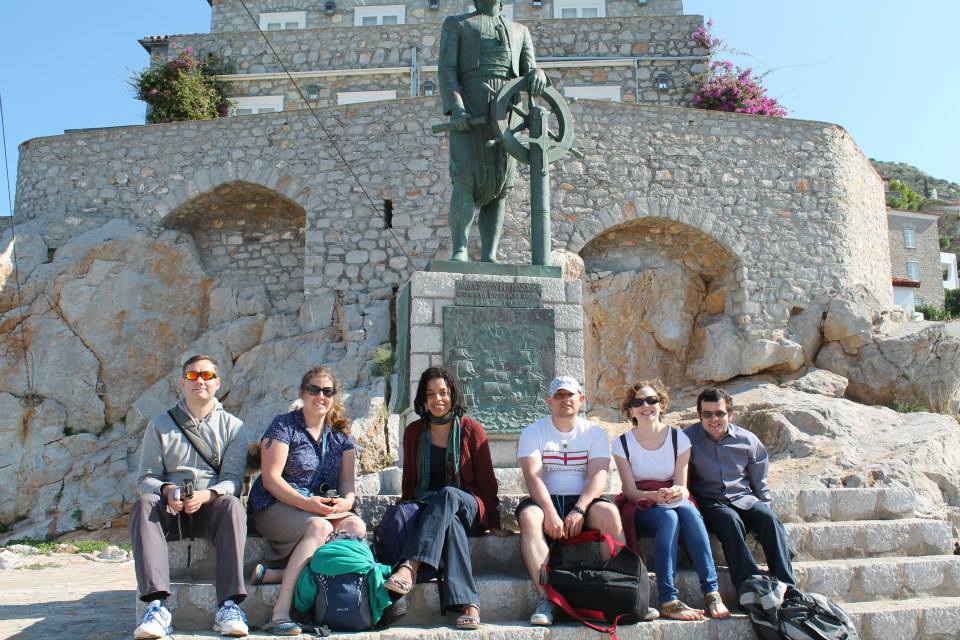
Our group took a walk up to the site of  old battlements that were a strategically important lookout point and a good place for a team photo.


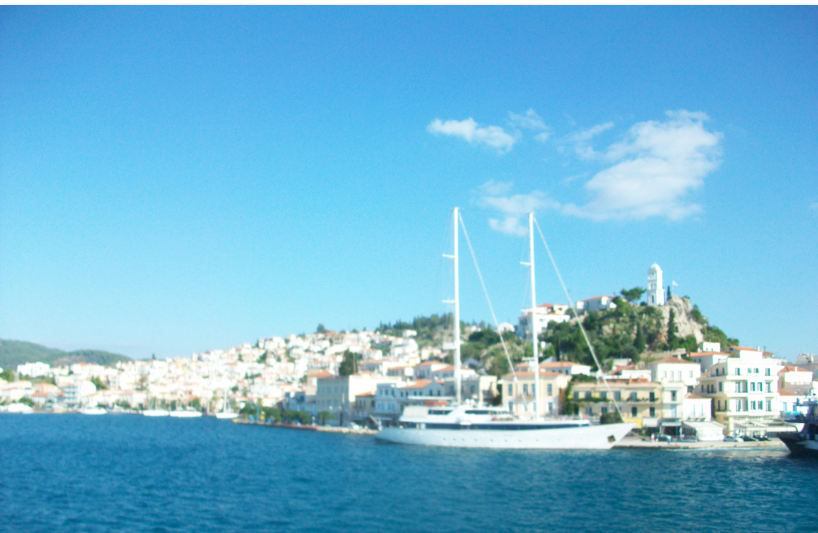
On our next stage of the voyage, an agreeable two course lunch was served. The cruise company were quite crafty in including food within the cruise tariff but leaving drinks as a cost option. The cruise company were quite crafty in including food within the cruise tariff but leaving drinks as a cost option.Our second stop was a brief stop at the sun kissed island of Poros. 


We only had 40 minutes here but this was enough time to visit the Clock Tower that sits above the town, offering panoramic views of the harbour. 


There was also a large Greek flag on a rock by the Clock Tower and Andy seemed to get carried away with many many legends of Greek military victories in days of yore by positioning himself as the conqueror of the nation,


The final stop of the day was on the island of Aegina, where we stopped off at the main town of Egina. This was a busy port town with numerous ferries stopping off before heading back to the mainland. We took the opportunity to stop off at a nice seafront café and walk down to the beach. 


Our group headed into town to the area near the marina to admire the Church of the Virgin Mary, before heading back to the boat just as the sun was setting.


We were underway on the final part of the cruise in tranquil waters as day gave way to night and the moon was rising over the island. 


Our group spent time sitting on the main deck of the boat being treated to a display of Greek dancing. The group then got up to participate in a communal traditional Greek dance. This was followed by a series of other dances and before long, some of the group were joining in with the Macarena just as we were navigating through the busy shipping channels in choppy waters. The voyage came to an end after 1930 though didn't get back to the hotel for more than 1 hour 15 minutes later due to heavy traffic in Athens as commuters were setting off for home.

The second organised excursion day started off with a brief stop off at the local Orthodox monastery. This featured some thought provoking iconography of Christian martyrs though our party arrived at a time when some form of service was taking place and were made to feel as welcome as a bacon sandwich at a synagogue. Examples include one member of our party being singled out for apparently not wearing appropriate clothing and at least one person was told not to take photographs. The picture below shows the main tower on the site.


Following this slightly sour experience, we headed to Agia Marina to catch a ferry for a 45 minute voyage to our main destination was the pretty seaside resort of Nea Styra on the island of Euboea. This was a pretty but very quiet location, partly due to the fact that most places were closed due to it being a bank holiday.


On walking through the main street, Steve stopped off at a cash machine at the local branch of Piraeus Bank who proclaimed themselves as the number one bank in Greece in an advert, an accolade that is up there with being the prettiest corpse in the mortuary. Rather like Old Mother Hubbard, when he got there, the cupboard was bare.


On the journey back to Nea Makri, we stopped off at Marathon Lake, with its imposing marble dam, to take in the sunset. 


Our evening began with a walk into town to visit the brilliant bakery and confectioner from which I had purchased a tasty chocolate cake for €0.50 the previous evening. We came away from the shop carrying two large boxes filled with so many cakes for around €26 that it felt like legalised looting.


We decided to have a more relaxed evening in the hotel lounge playing a board game. Unfortunately, the only choice presented to us was 2 in 1 Disney Princess of snakes and ladders or ludo. The game ended up with both Steve and Tim becoming increasingly competitive to become the top princess, and it was all tiaras, tantrums and bizarre mood swings as cries of 'I love Princess Ludo' or 'I hate Princess Ludo' could be heard in the ebb and flow of the game. This whole episode was undoubtedly metrosexuality at its lowest point.


The third organised excursion was to Athens, the capital city. We set off from Nea Makri and along the Marathon road. When we entered the city limits, we made our way to the site of the Panathenaic stadium that was used in the first modern Olympic Games of 1896. This was built on the site of an ancient stadium that hosted the Panathenaic Games in honour of the goddess Athena.


The main feature of our visit was a guided tour of the iconic Acropolis, a UNESCO world heritage site. The centrepiece of the site is the Parthenon, a temple dedicated to the goddess Athena, from whom the city derives its name. We learned of how Athena was born out of the head of Zeus in what really was the mother and father of headaches.


The Parthenon is undoubtedly the greatest icon of Athens, an essential part of its DNA in the same way as the Colosseum is to Rome and the Eiffel Tower is to Paris. In many ways, it is the eminent symbol of Greek civilisation even though there is much scaffolding in evidence as it undergoes renovation. On the day we visited, there were many tourists of different nationalities present and it was amusing to hear someone ask: “was Zeus a real person?”


Some of the treasures of the Parthenon are famously located in the British Museum, the hotly disputed Elgin Marbles. Our guide was diplomatic in saying that she doesn't  mind where they are located and was complimentary about the way in which the British Museum has looked after the sculptures, though she pointedly made reference to the new museum at the bottom of the hill which has space to accommodate the treasures. This impressive new building, located near the theatre of Dionysus, will be the cornerstone of future Greek bids to take back the priceless artefacts.


The tour gave us an insight to the contest between Athena, goddess of wisdom, and Poseidon, god of the sea, to become the patron deity of the city. Both of the gods had to present themselves before King Cecrops,the first king of the city, and produce a gift that would be to the benefit to all of the citizens. Cecrops was something of an odd creature in that he was half human and half snake, which seems to be a pre-requisite for a career in politics. The contest began when Poseidon struck the earth with his trident and created a well from which water streamed forth but this was salty and not much use to anyone. 

Athena struck the ground with her spear and planted an olive branch which naturally grew to be an olive tree. This was a gift of multiple dimensions as it gave the city dwellers olives, oil for cooking and lighting, as well as a source of wood for building. King Cecrops came to the conclusion that Poseidon was a bit of a one trick pony and Athena was able to claim the city. This contest was quite elaborate in the era before the invention of the penalty shootout. An olive tree sits at the Acropolis today on the spot where it is said that Athena had planted her tree.


The site of the Acropolis offers spectacular panoramic views of the city. It is possible to look out towards the four main mountains that sit above the city and out towards the Saronic Gulf.


Before leaving such a well known site, we decided to have the customary typical tourist photograph taken for posterity.


Following our cultural morning, we headed into the city for lunch and take in some of the other historical sites of this great city, including the Temple of Olympian Zeus, dedicated to the king of the pantheon of the gods.


On the way back to the coach, we headed to the heart of the city to witness the changing of the guard in front of the Tomb of the Unknown Soldier outside the parliament building in Syntagma Square, the area that is the beating heart of the modern city. The soldiers are members of the Presidential Guard, known as Evzones, standing proud outside their beach hut in traditional uniform that is derived from a design worn by Greek soldiers who fought against the Ottoman occupation.


Following the hustle and bustle of the capital city, we then undertook a 70km coastal road trip to Cape Sounion, the southernmost point of Attica, to take in one last Hellenic sunset in a site of great natural beauty, looking out to the Aegean Sea. This site is famous for its ruins of an ancient temple of Poseidon and is noted in mythology as being the spot where King Aegeus leapt to his death when he saw his son’s ship in the distance with a black sail, mistakenly believing that he had been killed in a clash with the Minotaur. It is from this king that the name of the sea is derived.


The final day of the holiday was spent at leisure in the Nea Makri, offering an opportunity to buy some last minute souvenirs. There were some upmarket boutiques in the town but you didn't need to scratch far below the surface to also find many disused shop units and unfinished building projects, each one an example of a dream broken on the altar of feckless fiscal policy.


It was also good to go out for lunch in another nice local restaurant and take in the nice coastal views that this pretty little town has to offer.


We had to leave Athens on the 0800 flight which meant that we departed Nea Makri so early that the night club was still in full swing.

Greece is a country that can lay claim to be an eminent civilisation in ancient times, recognised as a leading centre for philosophy, pioneer of mathematical advances and the cradle of democracy. There is a certain poignancy in realising that the nation of Plato, Socrates and Pythagoras of Samos that led the world in many ways, is now in an economic straitjacket with the standing of a second world country. Considering the predicament in which Greece finds itself, it is clear that this is a nation with a rich past that potentially faces an impoverished future.

Against this backdrop of financial crisis, this broken country needs tourism more than ever. Everywhere that we travelled, the Greek people were very welcoming. This beguiling land of myths and fables, with 227 inhabited islands and close to 5,800 more uninhabited islets empowers you to write your own odyssey, beckoning you to return time and again, safe in the knowledge that no two visits will ever be the same.